
Homeschooling
Personalized one-on-one math support designed to work with your child’s homeschool curriculum, needs, and goals.
Personalized Math Tutoring Built Around Your Child
Individualized instruction that works with your homeschool program.
One-on-one math tutoring designed around your child’s current level, curriculum, assignments, and goals—from foundational skills through advanced mathematics.
Whether your child needs to fill gaps, keep up with a demanding course, improve grades, or prepare for more advanced work, instruction changes as the child’s needs change.

What You’ll Receive
A complete tutoring system designed around your child—not a one-size-fits-all program.
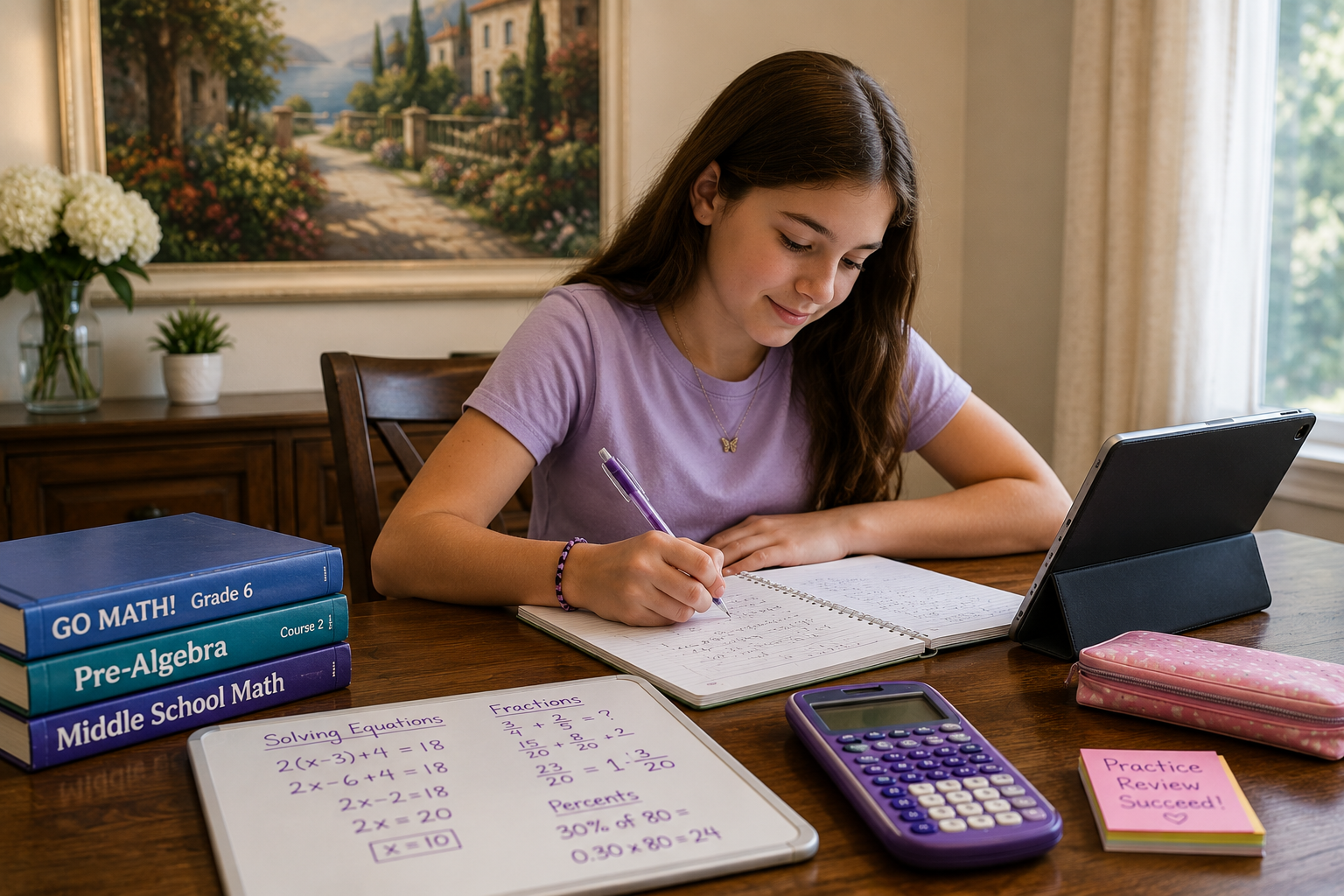
1. Initial Assessment
Identify strengths, prerequisite gaps, conceptual understanding, problem-solving skills, and recurring errors before instruction begins.

2. Individualized Instruction
Lessons are tailored to the student, the math course being used, current assignments, and the way the student learns best.
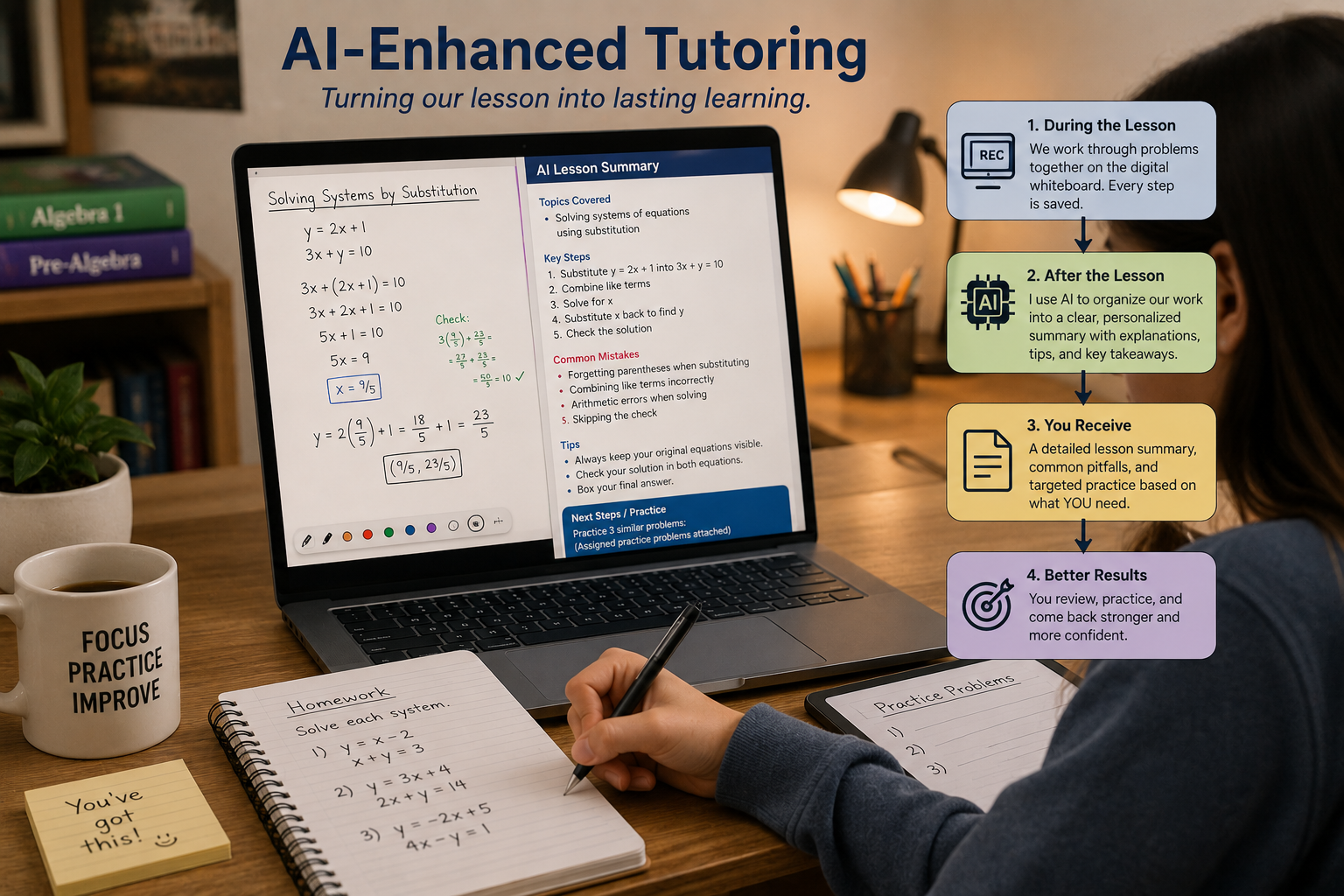
3. AI-Enhanced Lesson Materials
After each lesson, the actual work from our digital whiteboard is organized into clear explanations, solutions, tips, and common pitfalls.
4. Parent Lesson Summaries
You’ll receive a clear summary after each lesson so you always know what your child worked on, what improved, and what still needs attention.
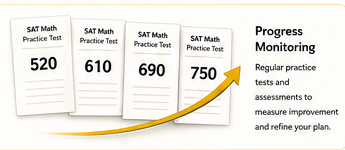
5. Ongoing Progress Monitoring
Earlier skills are revisited periodically so we can check retention, identify developing gaps, and adjust instruction before problems grow.

6. Goals & Future Opportunities
Stronger math skills can mean better grades now, greater confidence in advanced courses, and more options for college and beyond.
How the Tutoring Works
The overview above shows the full system. Here is a closer look at the parts that matter most in practice.
Built around your child
Individualized Instruction — Not a Prepackaged Program
Every student comes in with a different combination of strengths, gaps, assignments, course expectations, and learning habits.
Lessons are built around the work the student actually needs to do. We can work on current assignments and upcoming assessments while also identifying prerequisite skills that may be making new material harder than it needs to be.
As the student improves, the emphasis of tutoring changes too.
AI-enhanced review + targeted practice
The Lesson Doesn’t End When the Session Ends
A major part of the tutoring system happens after the lesson. The work completed on our digital whiteboard can be turned into organized lesson materials showing the mathematics we actually worked on together—not generic notes covering what a student might have learned.
- Clear explanations and worked solutions
- Important concepts and procedures
- Common mistakes and pitfalls
- Strategies discussed during the lesson
- Additional practice based on what the student needs next
AI helps organize the lesson. It doesn’t replace the tutor. The technology is used to make the instruction more useful after the session is over.
Parent communication
Parents Stay Informed
You shouldn’t have to wonder what happened during tutoring.
After lessons, parent summaries can explain what we worked on, where progress was made, what still needs attention, and what the student should work on next.
That makes it easier to see tutoring as an ongoing process rather than a series of disconnected appointments.
Progress + retention
Progress Is Measured Over Time
Improving today’s assignment matters. Keeping the skill matters too.
Earlier material is revisited periodically to see whether the student still understands it. That helps identify skills that were learned temporarily but have not yet become secure, as well as new gaps that appear as the mathematics becomes more difficult.
Instruction and practice can then be adjusted before a small weakness becomes a larger problem.
Practice with a purpose
Targeted Practice
Instead of assigning more work simply for the sake of doing more problems, additional practice can focus on the specific skills, errors, and misunderstandings that appear during lessons.
As those needs change, the practice changes with them. That can mean reinforcing a prerequisite skill one week, preparing for an upcoming assessment the next, and later returning to an earlier concept to make sure it was retained.
From Better Math Skills to Bigger Opportunities
The immediate goal may be tomorrow’s homework, next week’s test, or this semester’s grade. Stronger mathematical foundations can also affect what comes afterward—advanced courses, academic interests that require quantitative skills, and more choices when children begin thinking about college.
Organization + independent learning
Organization, Study Skills & Time Management
Homeschooled students often have to manage assignments, materials, deadlines, and study time with more independence. Tutoring can include practical support for organizing schoolwork and developing routines that make that independence easier.
We can work on planning assignments, breaking larger tasks into manageable steps, keeping track of priorities, preparing for tests, and using study time more effectively.
The goal is not simply to finish today’s work, but to help the student become more organized, consistent, and increasingly able to manage schoolwork independently.

Math Tutoring From Foundations Through Advanced Courses
Children may need very different kinds of mathematical support at different stages. Tutoring can range from strengthening foundational skills and pre-algebra through algebra, geometry, precalculus, statistics, SAT math, and advanced high-school mathematics.
The same basic approach remains: understand the student’s current needs, teach for understanding, practice strategically, and build skills that carry forward.
Advanced Math & Calculus
For children taking calculus or preparing for advanced mathematics, tutoring can go beyond getting through individual homework problems.
Calculus & advanced mathematics
Master Calculus. Build Understanding. Reach Your Goals.
From concepts to confidence—step by step.
Deep Conceptual Understanding: Understand why the mathematics works—not simply memorize procedures.
Problem-Solving Skills: Develop strategies for approaching unfamiliar and increasingly complex problems.
Test & Exam Preparation: Prepare for quizzes, course exams, and AP Calculus assessments.
Preparation for What Comes Next: Build the mathematical foundation needed for future quantitative coursework.

Let’s Talk About Your Child
Every homeschool family is different. We can discuss your child’s curriculum, current level, strengths, difficulties, and goals and determine the kind of math support that makes sense.